

A Conversation with Patrick Plourde
Answers have been edited for length and clarity.
Interview by Anna Kim, Bowdoin College Class of 2028
What was the inspiration behind “Pinecone Pair with Tassel?” How did you start creating them?
I have a collection of natural objects in my house, like pine cones and pine needles. It really is a fascicle [with] five needles per group on a tassel. Tassels are part of the Maine state flower, but they’re more than just a bunch of pine needles on a stick.
It never occurred to me to put the shovels in that configuration until I had a big enough pile of them where they were stacked in such a way that it suggested pinecone and I said, “Oh of course, yeah!” I made one right away, and then the rest is history.
I had to fine tune the size and layout process, but now they kind of just fall together and they’re really cool to make. Sometimes I catch myself asking, “Why the hell am I doing this?” because it’s not easy. But the end result is so fun, and people love it.
Can you share more about your studio? How does that space influence your art?
My studio shop is the most important place in my life. I’m here every day. I do consider it a practice and that’s important that people know that.
I’ve never not had a studio or shop space since I got out of art school. I always made art. Since I work in recycled materials, I collect a lot, and so the shop is full of objects that may or may not work their way into a piece. I have file boxes categorized with certain parts and elements that are just waiting to be picked at and put into pieces.
Do you have rituals or routines in your practice that have stayed the same even as you’ve moved between studios?
I always try to find a place that has good lighting, and I don’t mean lighting indoors. I mean natural light that will come through the windows and doors because I like to work in the evening.
I’ve had good lighting situations in every studio, and I was lucky to find this one [in Lisbon Falls], where it faces west and upriver. I’m really near the Androscoggin River, so I get these beautiful sunsets in this nice low light, and I love that.
It’s kind of cliche, but [my art] is centered around nature. My life has become pretty simple now. I don’t really do much other than work – I swim every day at the pond, and drink coffee.
How long does it take you to make one Pinecone? What does your process look like?
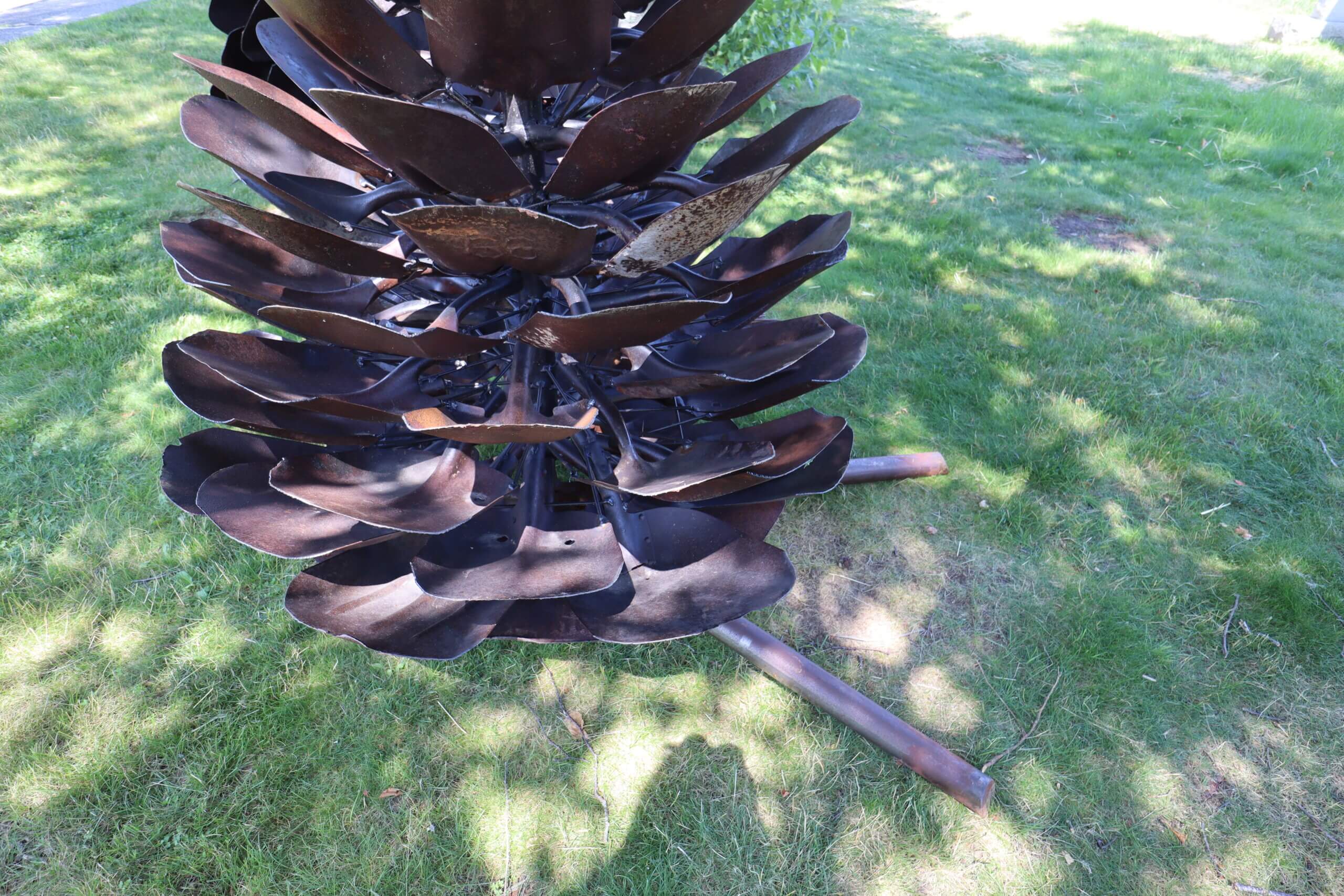
It’s more than just welding them together. I call it “processing” to get the shovels from the scrapyard. Some have handles and some don’t, and they have to be cut to length because the longer ones are at the bottom, and as you work your way up the pine cone, they get shorter and shorter and change shape.
So I prepare all those shovels. I cut the corners off, the square ones, start at the bottom, and as they work their way up, they get reinforced with other metal. If you look inside, you can see all the little quarter-inch rods that support the whole thing.
I think the Pinecones in Freeport have about 82 shovels per cone.
Why do you think the Pinecones are so popular?
People recognize it, but it’s out of context. It’s way bigger than what they normally see, and it makes them chuckle.
Many of them don’t even notice its shovels for the longest time because they’re just taken by the whole piece, which is really interesting.
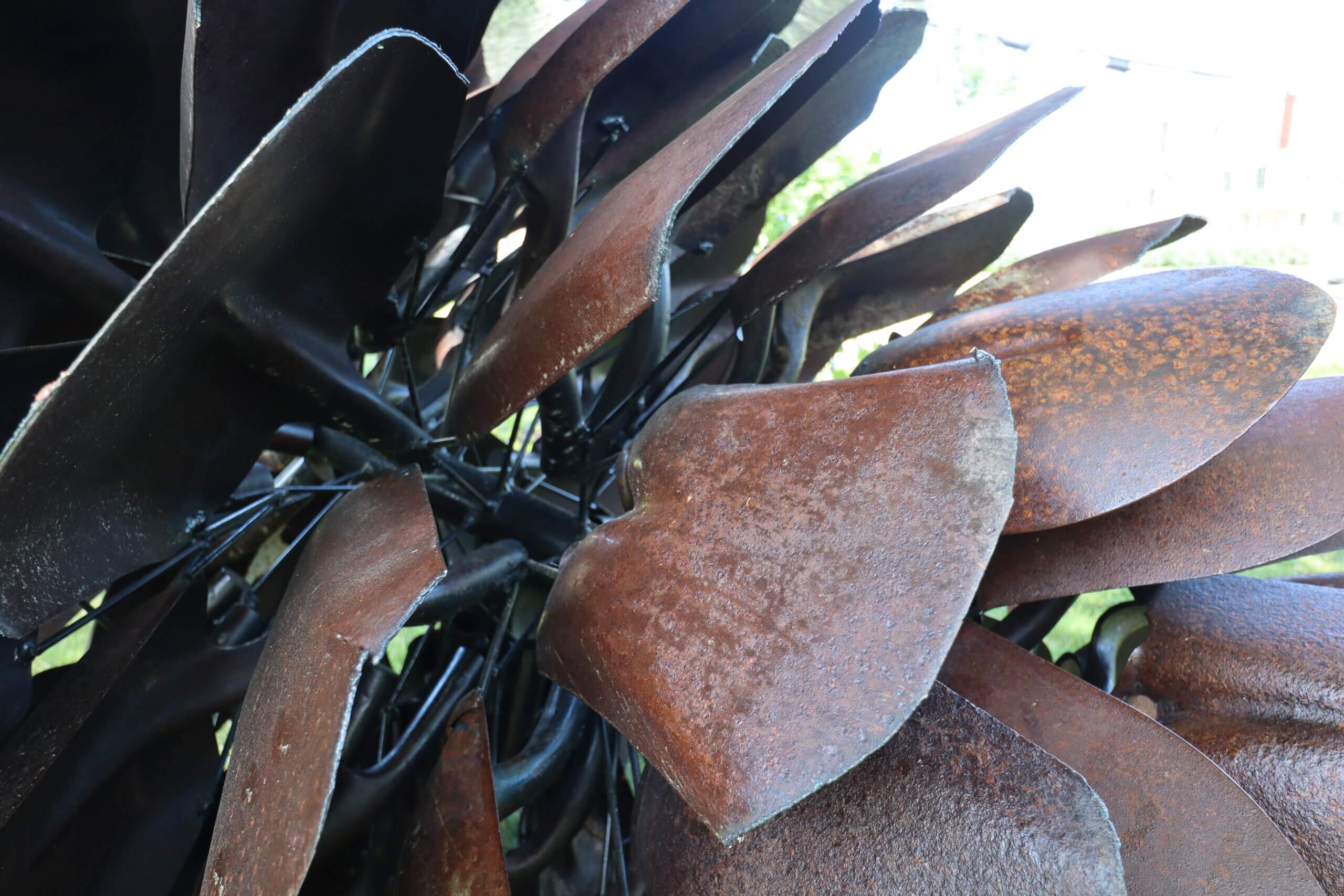
“Pinecone Pair with Tassel” is featured on the lawn of the Freeport Town Hall. How do you want people to interact with them?
It’s like directing somebody to a painting in a museum. I can’t control that. People are naturally drawn to it because they recognize it as a pine cone. It’s not something they have to poke around on the ground for. It’s right there in front of them.
They walk up to it and examine it, and then some of them realize it’s shovels. Some of them start laughing hysterically. Then they start questioning, “Oh, look at how it’s built.” If they’re really inquisitive, they’ll notice the big wide grain and snow shovels at the base, and then the small landscape shovels at the top, the narrow ones working your way through the spades.
Another fun thing about it is having all these different types of shovels to use to source from, and they all have a different use. Many of them have been worn down.